Moving to Thailand is a sequence of eight decisions taken in a fixed order: the visa, the arrival card, the address registration, the bank account, the home, the schools, the health cover, and the 180-day line that makes a person a Thai tax resident. Almost nothing about any single one of them is hard. What goes wrong is the order. This is the sequence, with the figures that were true on 1 September 2026 and the official source behind each one.
- 30 days
- visa-free, from 15 September 202660 countries and territories, for tourism. The 60-day exemption ends the same day
- 180
- days in a calendar year, and you are a Thai tax residentCounted on any visa, or none
- 49%
- of a building's saleable area, the foreign freehold quotaCondominiums only. Land is not available to a foreign buyer
- 59
- homes on Embark's own rental registerIn 13 buildings across 7 central corridors, from THB 120,000 a month
The date that changes the first decision
From 15 September 2026 the visa-free stay drops from 60 days to 30, and it is framed for tourism only. Thirty days is not enough to find a home and open a bank account, so anyone moving here needs a visa before they fly.
Read the full explanation
On 15 September 2026 Thailand’s 60-day visa exemption ends. From that day, holders of passports and travel documents from 60 countries and territories may enter visa-free for tourism for up to 30 days. Seychelles and Mauritius move to a 15-day exemption. Azerbaijan, Belarus and Serbia move to visa on arrival. The Ministry of Interior announcements behind the change were published in the Royal Gazette on 31 August 2026, so this is settled law rather than a proposal.
Two details matter more than the number. The new measure is framed for tourism, and it drops the reference to short-term work and business engagements that the 60-day scheme carried. And 30 days is not enough time to find a home, open a bank account and register a lease. Anyone moving here needs a visa before they fly, not after they land.
Start with the visa, because everything hangs off it
The visa decides the bank, the lease, the school enrolment and the tax position. Four routes carry real residents, and which one fits is a question of age, income and intention rather than preference.
DTV
The Destination Thailand Visa: five years, multiple entry, stays of up to 180 days each, extendable once in-country. Evidence of THB 500,000 in funds, fee THB 10,000. Built for remote workers and for Thai soft-power activities. There is no property route into it.
LTR
The Long-Term Resident visa, run by the Board of Investment: ten years, granted five and renewed five, with annual reporting in place of the 90-day cycle and an exemption on foreign-sourced income. The Wealthy Global Citizen route asks USD 1 million in global assets with USD 500,000 invested in Thailand. Fee THB 50,000.
Retirement
A Non-Immigrant O for applicants aged 50 and over, extended a year at a time on THB 800,000 held in a Thai bank, or income of THB 65,000 a month, or a combination reaching THB 800,000 a year. Funds parked to clear the threshold and then withdrawn are the most common reason an extension is refused at renewal.
Employment
A Non-Immigrant B with a work permit, sponsored by the employer. The permit is tied to that employer and that role, so it moves when the job does.
We have written the DTV and the LTR up in full, side by side, in DTV or LTR: which door into Thailand is yours. One point is worth repeating here: buying a condominium does nothing for a DTV application, and under the LTR it counts only once title is registered in your name. Instalments on an off-plan unit do not count.
The three pieces of paper nobody warns you about
- The Thailand Digital Arrival Card. Required of every foreign national entering by air, land or sea since 1 May 2025, including children. It is filed online within three days before arrival and it is free. The official portal is run by the Immigration Bureau. Any site charging a fee for it is not the official one.
- The TM30. The residence notification, filed by the landlord, hotel or accommodation provider within 24 hours of your arrival at the property. Not by you. It matters because the officer handling a later extension checks that it is current, and a landlord who has never heard of it becomes your problem on the day. Ask in writing before signing a lease.
- The 90-day report. Anyone staying beyond 90 days notifies Immigration of their address every 90 days, online, by post or in person. Missing it is a fine of around THB 2,000. An LTR holder reports annually instead.
A relocation goes wrong in the order, not in the detail. Nearly every expensive mistake we see is a decision taken before the one it depended on.
Money, and the account you cannot open in a week
A Thai bank account is the piece that takes longest and blocks the most. It needs the visa first, and often an address.
Read the full explanation
A Thai bank account is the hinge of a settled life here: the salary, the rent, the school fees and the utilities all run through it. Banks generally want a long-stay visa, a work permit or a registered address before they open one, which is why the visa comes first and the account second. Plan for it to take weeks rather than days.
If a purchase is in the plan, the money moves differently. For a condominium to register freehold in a foreign name, the purchase funds generally have to arrive from abroad in foreign currency and convert to baht in Thailand. On a qualifying inward transfer the receiving bank issues the Foreign Exchange Transaction form, which is what the Land Office wants to see. The full sequence is in how to buy a Bangkok condominium, step by step.
Rent first. Buy second.
Bangkok is not one market. It is a set of corridors that behave differently by the hour, and the difference between a 20-minute commute and a 70-minute one is a judgement nobody makes accurately from abroad. Six to twelve months on a lease answers it, and it puts a buyer in the city for the viewings, which is where the real price of a building becomes visible.
The first year
Rent for six to twelve months
Learn the corridor, the commute and the building before committing capital. Embark's own register holds 59 homes in 13 buildings across 7 central corridors, from THB 120,000 a month. Standard leases run one year, with two months' deposit and one month in advance.
Buy on arrival
Faster, and occasionally right where the corridor is already known from earlier stays. It commits the largest sum in the move to a judgement made before the city has been lived in, and a condominium is not quickly undone.
Where in Bangkok, and why the corridor decides the day
Pick the area by the commute and the school run, not the building. It is the one decision you cannot undo by moving furniture.
Read the full explanation
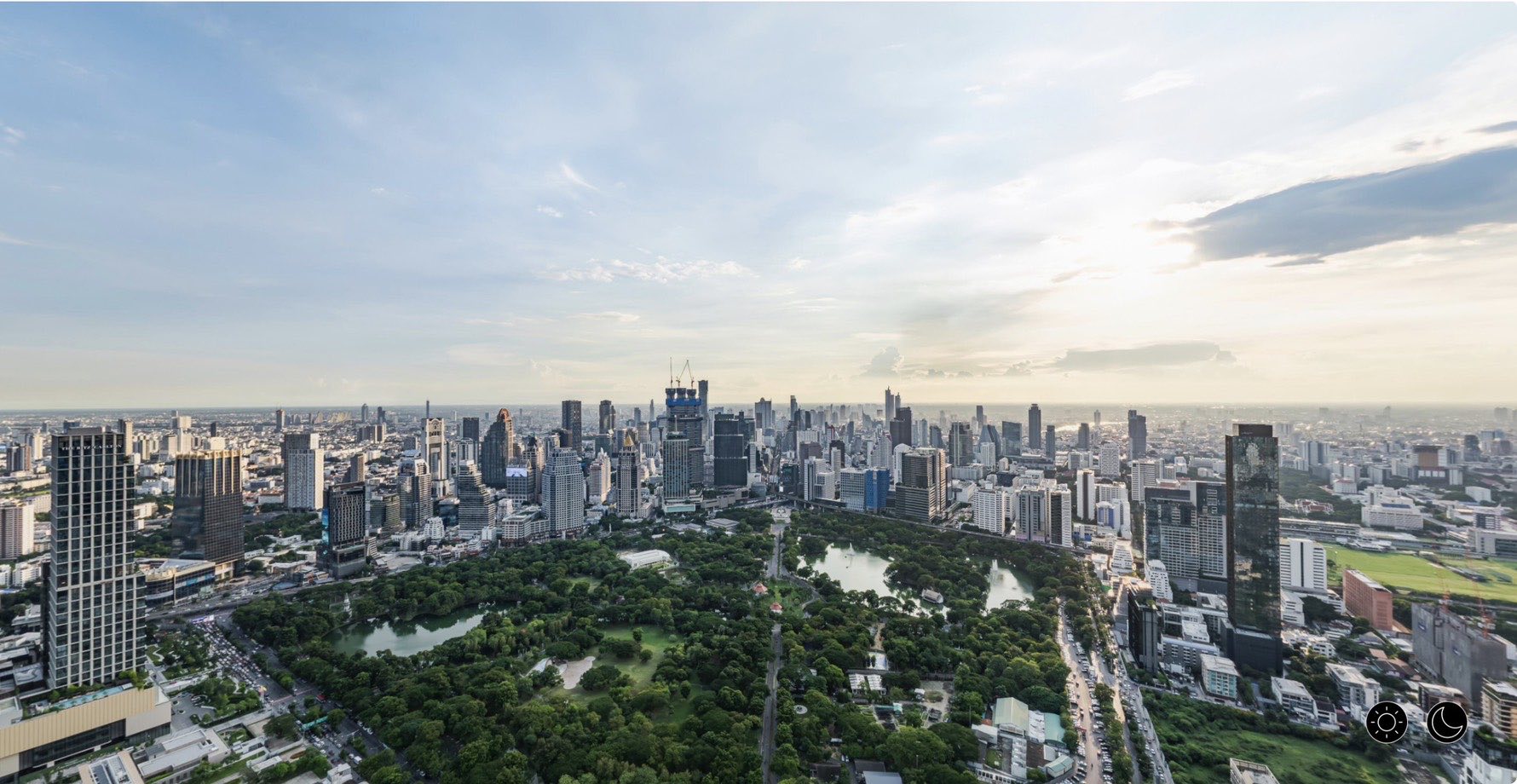
Three corridors carry most of the international residents. The Lumphini park-axis runs from Wireless Road round the park to Rama IV: embassies, the park, the shortest walks to the two BTS interchanges, and the highest land values in the city. The Sukhumvit corridor runs east from Ploenchit through Asok, Phrom Phong and Thonglor: the deepest supply, the largest international community, and the school buses. The Riverside corridor trades commute time for space, air and quiet.
The rule of thumb we give clients with children is simple. Choose the school first, then the corridor that puts the school within 30 minutes, then the building. Doing it the other way round is how families end up moving twice.
Schools, and the fee that is not the tuition
The tuition is the number everyone quotes. The one-off fees at enrolment are the one that surprises people.
Read the full explanation
Bangkok has one of the largest concentrations of international schools in Asia. For 2026/27 the established names publish annual tuition of roughly THB 216,000 for a part-time nursery place to more than THB 1.25 million in the sixth form. Bangkok Patana runs about THB 545,000 to 1,044,000 a year across the age range, NIST about THB 630,000 to 1,095,000, and Shrewsbury about THB 720,000 to 1,120,000.
Tuition is not the whole bill. Most schools add an annual capital or development fee, a one-time application and enrolment charge, and a refundable deposit. Boarding, where offered, sits on top: Harrow publishes about THB 456,700 for weekly boarding and THB 571,100 for full, in addition to tuition. Some schools publish nothing at all and quote on application. Places at the established schools are taken early, so the enrolment conversation belongs at the start of the move rather than the end.
Healthcare, and the cover that replaces the state
There is no state safety net for a foreign resident. Your policy is the whole of it, and some visas require one.
Read the full explanation
Foreign residents use the private hospital system, and it is the reason many of them are comfortable here. Bumrungrad, Samitivej and BNH run to an international standard with English-speaking specialists and short waits. There is no state safety net for a foreign resident outside the social security system, so private cover is not optional. Some visa categories require it in writing: the LTR asks for health insurance covering USD 50,000, or Thai social security, or USD 100,000 held on deposit.
The 180-day line
Spend 180 days here in a calendar year, on any visa or none, and you are a Thai tax resident. It is counted, not elected.
Read the full explanation
Spend 180 days in Thailand within a calendar year and you are a Thai tax resident, whichever visa you hold and whether or not you hold one. A Thai tax resident is taxable on Thai-sourced income and, since 1 January 2024, on foreign-sourced income in the year it is remitted into Thailand.
A two-year exemption window for remittances has been drafted and widely discussed since 2025. As of September 2026 it has not been published in the Royal Gazette and it is not law, so the rule that applies to money moved this year is the one in force since January 2024. The LTR visa carries its own exemption on foreign-sourced income, which is the single biggest reason a high-income mover looks at it. This is the part of a relocation where a Thai tax professional pays for themselves before you move anything.
Pets, shipping, and what not to put in the container
Both are solvable and both need starting earlier than feels necessary.
Read the full explanation
Cats and dogs come in by air against an import permit issued by the Department of Livestock Development, a microchip, a current rabies vaccination and a veterinary health certificate issued shortly before travel. The Department sets the requirements and the timings and the airlines set their own rules on carriage, so start the paperwork months before the flight and confirm both with the Department and the airline.
On the container: Bangkok apartments come furnished far more often than European or American ones, storage is tight, and heat and humidity are unkind to veneered furniture and to anything upholstered in wool. Most people we advise ship less than they planned and are glad of it. Art, rugs and anything with sentimental weight are the exceptions worth the freight.
What we would do, in order
- Pick the visa route and start it from your home country, months ahead. It gates everything below.
- Choose the school, if there are children, and get on the list. Places, not fees, are the constraint.
- Choose the corridor that puts the school or the office inside 30 minutes.
- Book a serviced apartment for the first four to six weeks. Do not sign a year’s lease from abroad.
- File the arrival card within three days of flying, and confirm the landlord will file the TM30.
- Open the bank account, then move the standing costs onto it.
- Sign a one-year lease in the corridor you have now actually lived in.
- Take tax advice before the 180th day, not after it.
- Then, and only then, look at buying. Nine months in the city is worth more than any amount of research from abroad.
