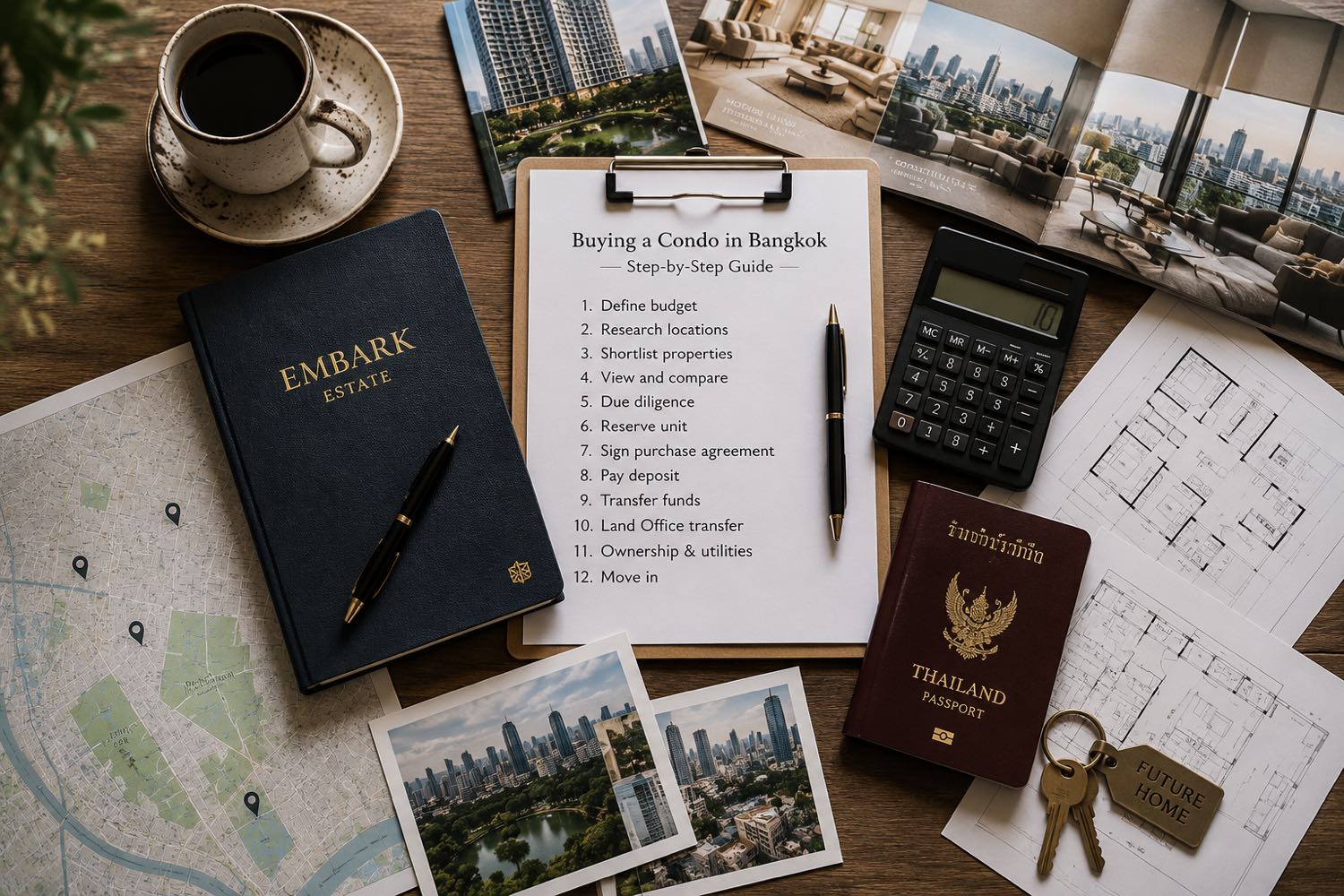
Buying a Bangkok condominium as a foreigner is an eight-step process in Thailand, running from the choice of corridor and building to transfer day at the Land Office, where the deed is registered in the buyer’s name within the Condominium Act’s foreign quota. This is the ledger of the whole purchase, in order. Each entry is short by design. Where a step deserves a full guide, we have written one, and it is linked.
- 8
- steps, in orderFrom the choice of corridor to the keys
- 7 to 14
- days to review the SPAReasonable in Bangkok; shorter is a flag
- USD 50,000
- FET form thresholdIssued by the receiving Thai bank on a qualifying inward transfer
- 1%
- of the price, roughly, on transfer dayA buyer's cashier's cheque by convention; the fee about 2% of appraised value, split equally
- Decide the corridor, then the building. The advisor’s side of the work: sourcing, market context, negotiation.
- Reserve the unit. A short agreement and a small deposit; ask when the SPA arrives, in which languages, and with how many days for review.
- Legal review, then the signature. A Thai property lawyer reads the SPA before it is signed.
- Bring the funds in from abroad. Foreign currency in, converted to baht in Thailand; the FET form from USD 50,000.
- Pay against milestones. Reservation, signing, instalments during construction, balance at transfer; escrow is not standard practice.
- Inspect before accepting. Independent inspection, defect list, remediation, re-inspection, then acceptance.
- Transfer day at the Land Office. The deed registered in the buyer’s name; a cheque of roughly 1 percent of the price by convention.
- After the transfer. Sinking fund, first-year common-area fees, then the keys.
1. Decide the corridor, then the building
The purchase starts before any unit is viewed. Central Bangkok is a set of distinct corridors, each with its own buildings, price levels, and rhythm, and the first decision is which of them fits the buyer’s life. This is the advisor’s side of the work: sourcing, market context, and negotiation. The legal side belongs to a lawyer, and the division between the two roles is set out in our guide to agents and lawyers in Thailand.
2. Reserve the unit
The reservation agreement is a short document signed at booking, with a small deposit that holds the unit while the buyer arranges payment and reviews the full contract. The question to ask at this stage: when will the sale-and-purchase agreement be issued in final form, in which languages, and with how many days for review? In Bangkok, seven to fourteen days is reasonable. Shorter is a flag.
3. Legal review, then the signature
A Thai lawyer with property experience reads the sale-and-purchase agreement, the SPA, before the buyer signs it. The review confirms the title is clean, the unit falls within the building’s foreign quota of up to 49 percent of saleable area, and the annexes actually contain what the marketing promised. Embark does not provide legal review; we coordinate the introduction and stay in the room. The full list of questions is in our guide to signing a Bangkok condominium sale agreement.
4. Bring the funds in from abroad
For a freehold to be registered in a foreign buyer’s name, the purchase funds generally have to arrive from abroad in foreign currency and be converted to baht in Thailand. On a qualifying inward transfer of USD 50,000 or more, the receiving Thai bank issues the Foreign Exchange Transaction Form, the FET form, formerly known as the Tor Tor 3. That form is the Land Office’s evidence of the foreign remittance. For smaller amounts, a bank credit advice can serve the same purpose. Keep every piece of this paperwork.
The price is one line in the ledger. The other entries decide whether the purchase closes cleanly.
5. Pay against milestones
Bangkok condominiums are typically sold on a milestone schedule: reservation, contract signing, instalments during construction, balance at transfer. Escrow is not standard practice in Thailand, so ask what proportion of the price falls due before completion and what protection stands behind it. On a completed resale, the schedule collapses to deposit and balance.
The payment schedule, by purchase
New development
Reservation, contract signing, instalments during construction, balance at transfer.
Completed resale
Deposit and balance.
6. Inspect before accepting
A new unit is delivered against a contractual specification, and once it is accepted, the developer’s repair obligation narrows sharply. An independent inspection consultant runs the full unit, the defect list goes to the developer, the remediation work is done, and a re-inspection verifies it. Only then does the buyer accept. The process is covered in full in our guide to the Bangkok handover inspection.
7. Transfer day at the Land Office
On transfer day the deed is registered in the buyer’s name at the Land Office. The day carries costs. The transfer fee has commonly been about 2 percent of the official appraised value, and common practice is to split it equally between buyer and seller, so by convention a buyer budgets a cashier’s cheque of roughly 1 percent of the price for the day. The SPA specifies who pays what, and the full fee table sits in our guide to the true cost of buying in Thailand.
8. After the transfer
On a new development, two payments follow: the sinking fund, a one-time amount set aside for future major repairs and usually calculated on the size of the unit, and the first year of common-area fees, usually paid upfront. Then the keys. A delivered unit is a frame, not a home, and most buyers we work with move straight into fit-out from here.